Wednesday, April 25, 2012

1910 Gold Silk Dress

Lovely floor length gold silk crepe dress, with a slightly higher than natural waist. It sports a higher square neckline, and just a hint of a pigeon front. The outer sleeves are cut in the kimono style, as a part of the bodice, and notched on the outside. The under sleeves are separate from the bodice, more fitted, and covered in 1” tucks. 
Both collar and sleeves are decorated with a beautiful hand made lace. The lace crosses the outer part of the bodice, and lines the split front of the dress, as well as creating a V-shape on the back of the bodice. Inside the lace V, the front of the bodice is covered in tucks similar to the under sleeves. 
Closures on this dress are a little confusing. The bodice lining fastens down the center front with hooks and eyes, but the outer dress fabric does not fasten here at all, because it is partially sewn to the lining, and simply hangs closed. The rest of the dress fastens with hooks and eyes starting at the point of the lace V in front and proceeding down along the lace line on the left side of the dress. The closures are well hidden in the fabric.
The fabric of this dress is very delicate and lightweight. It is amazing how wonderful it has held up in storage. The lace is in less perfect condition unfortunately. Time and moisture have caused it to become yellowed and stained.
This garment is probably from 
very close to the year 1910, given that it shows some of the sleeve characteristics of a year or two earlier, but a silhouette that is similar to dresses made a year or two later.
Measurements:
Bust: 41"
Waist: 33"
Hips: 60"
Neck to Waist Front/Back: 13/11.5"
Armscye to Armscye Front/Back: 17/16.5"
Skirt Length: 41

Blog Post By Kelsey Oliver :) My final post

Friday, April 13, 2012

1950s Wedding Gown

This dress is easily my favorite piece in our collection. Its a wedding gown from the 1950s made from a heavy synthetic fabric, netting, and lace. The skirt of this garment is full and floor length,  with an underskirt  made of the heavier synthetic fabric and slightly narrower than each successive layer of netting. There are three layers of netting in all, and the outer most has a finished edge. The skirt ends in back in a long full net train.

The bodice of the gown is fitted, with darts on either side and in front, and is also made of a heavier fabric overlaid with netting. The lace at the neck comes down into a deep V in front but covers enough to remain modest. The necklinemakes a kind of scalloped shallow V, and comes almost off the shoulder, but not quite. The look is very 50s. There are also Vs in the lace at each sleeve, and matching lace at the slightly lowered waist. 
This lace is made with a mesh base covered in embroidery and cutwork. It's scalloped on one side and pointed on the other. 
The short fitted sleeves are made entirely of gathered mesh, overlain with lace.  In back, a long row of mesh covered buttons fastens the back of the dress to below the waist.
This garment is fairly simple in design and construction, but it beautifully captures the essence of the 1950s. And it's in very good shape, especially considering its white and made mostly of netting. The fabric shows slight yellowing all over making it a light cream color, but other than that shows no damage.
Measurements:

Bust: 34"

Waist: 25"

Hips: 60"

Neck to Waist Front/Back: 10.5"/11"

Armscye to Armscye Front/Back: 17"/19"

Skirt Length: 38" (Not Including Train)


Blog Post By Kelsey Oliver :)
 

Wednesday, March 7, 2012

1910 Cotton Frock

Another cream colored, one-piece dress from the very early 1910s made of a cotton batiste. Yellowing over time has probably caused the color of this dress, likely once white. White was the most popular color for ladies dresses in this decade. 
This dress has fitted 3/4 length kimono style sleeves, which means that the sleeves and bodice are cut out of the same piece of fabric, not sewn together. Fitted sleeves appeared in 1910, as did the kimono style. The higher neckline of this garment is another good indicator that it was worn early in the decade, before necklines made their dramatic drop, around 1914. The looser fit of this garment would also put it very early in the decade, likely no later than 1911, as this is the year narrow tube-like skirts became the norm. 
Decorations include off center bodice ruffles,  pintucks on the bodice and skirt (1/4 apart on bodice and upper skirt, 1/2 apart on lower skirt) and large horizontal tucks to look like trim at the hem; there are 4 rows. The front decoration is made of a machine made diamond ground lace, which is also used at the waist line and along the skirt and sleeve cuffs. The ruffles are a net trimmed with machine made lace.
The only fastenings on this dress are the buttons up the back; the dress fastens from the neck to bellow the waist. Buttoning up the back was another convention that began around 1910.
Overall this dress is in good shape, and the fabric is holding up well, but there are a few stains on the shoulders, front and hem of the garment on top of the fact that the whole piece is slightly discolored.
Measurements
Bust: 35.5"
Waist: 30"
Hips: 50"
Neck to Waist Front and Back: 11.5/11.5"
Armscye to Armscye Front and Back: 24/16.5"
Skirt Length: 34.5"


Blog Post By Kelsey Oliver

Friday, March 2, 2012

Late 1910s Purple Silk Frock

This lovely piece is a silk frock dating to approximately 1918, as indicated by the waist height, use of snaps, neck and collar style, darker fabric, and tiered skirt. The under-layer of the dress has a square neck and is overlapped with several semi-sheer layers of fabric in a v-shape. Square neck lines were common after 1914 and the small sailor collar seen on the back of this dress became a fashion around 1911, persisting throughout the war. 
The sleeves are sheer, long (indicating day wear), and decorated with tassels, the same as those on the outer-skirt and hanging end of the sash. The panels of decoration seen on the front and back of the bodice and the

 hanging tassels are hand-embroidered silk,
and the embroidery is done with a metallic thread. (Left)
On this garment the waist falls slightly lower than the natural waist, and the hem of the garment is uneven and slightly shorter than full length. The sheer outer layer of the skirt is split on both sides. The wider skirt, shorter hem,  and lower waist indicate that this dress was manufactured nearer to the end of the decade. Though delicate and beautiful, this dress sports minimal frills and lace, another indication that it was made near the start of, or during US involvement in WWI.The closures on this garment are very complicated. The sleeves snap at the wrist (snaps appeared after 1915) and the skirt hooks to the bodice in front with hooks and eyes. A sash hooks on the left side over top of everything.
Not too complicated, until; you get to the bodice, which closes in a series of overlapping layers, all with strategically placed and hard-to-find hooks and eyes. Underneath all of this is a sheer lining which hooks down the center front and a solid heavy woven waist band which also hooks in the center front. Surprisingly all of these closures are still intact.The garment is in quite good shape considering the delicate fabric it is made of, and it weight and age.
The metallic embroidery makes it very heavy and prone to tearing. There are a few evident tears, notably on the front bodice panel, but the dress is remarkably well intact. Some of the sheer lining is also torn, and the hem is  slightly discolored, probably from light exposure.
Measurements
Bust: 43.5"
Waist: 32.5"
Hips:41"
Neck to Waist Front/Back:10.5/14.5"
Armscye to Armscye Front/Back: 23/20"
Skirt Length: 33.5"
My favorite feature on this garment is the tag inside the waistband which reads "The Wonder Fresno, Cal" A little piece of local history.

Blog Post by Kelsey Oliver :)

Friday, February 24, 2012

Grey-Blue Silk Dress c. 1915


Another beautiful garment from the deep recesses of our storage. This is a full length silk dress, sewn all together as one piece. It has a narrow skirt, decorated with false,  fabric covered buttons from waist to almost hem down the center front. The skirt gathers into the center front seam, near the hem, causing it to gather inwards in the front, which in turn causes the drape you see. The skirt ends up being slightly shorter in front than in back. 
The dress also has a waist band which wraps around and attaches in back with small bow. The pigeon front bodice gathers in a V into the front of this waistband. A lace modesty guard in the deep V neck has been torn with time, but you can still see what purpose it once served. The rest of the lace on this garment is different from that seen in the modesty guard. On the six inch hip panels and lace collar we see a  cutwork bobbin lace (Honiton?). The modesty guard conversely is a machine made filet lace. The sleeves sport a different machine made lace. 
These sleeves, 3/4' in length, with a full outer sleeve decorated with buttons, and an gathered-in under sleeve made of lace with main fabric trim, are a good indicator of what this dress would have been worn for. 
It was probably a simple dinner dress, or a very nice day dress, as an evening gown would have had no sleeves, and a much deeper V-neck. This sleeve length and gown style indicate the garment dates to about 1914/15. 
The garment closes mostly with hooks and eyes, at the left shoulder and down the center back. It has a lining which also closes with hooks and eyes. The buttons are solely for decoration.

Some Measurements:
Bust: 40"
Waist: 24.5"
Hip: 38"
Neck to Waist Front/Back: 9.5/12.5"
Armscye to Armscye Front/Back: 24/16.5"
Skirt Length: 37"

The garment is still all in one piece, but not in excellent repair. There are several small tears and stains, the fabric is discolored, and the lace on the bodice is very worn and dingy.  It is, however, still an excellent representation of the fashions of the mid 1910s.

Blog Post by Kelsey Oliver :)

Friday, February 17, 2012

Early 1910s Day Dress


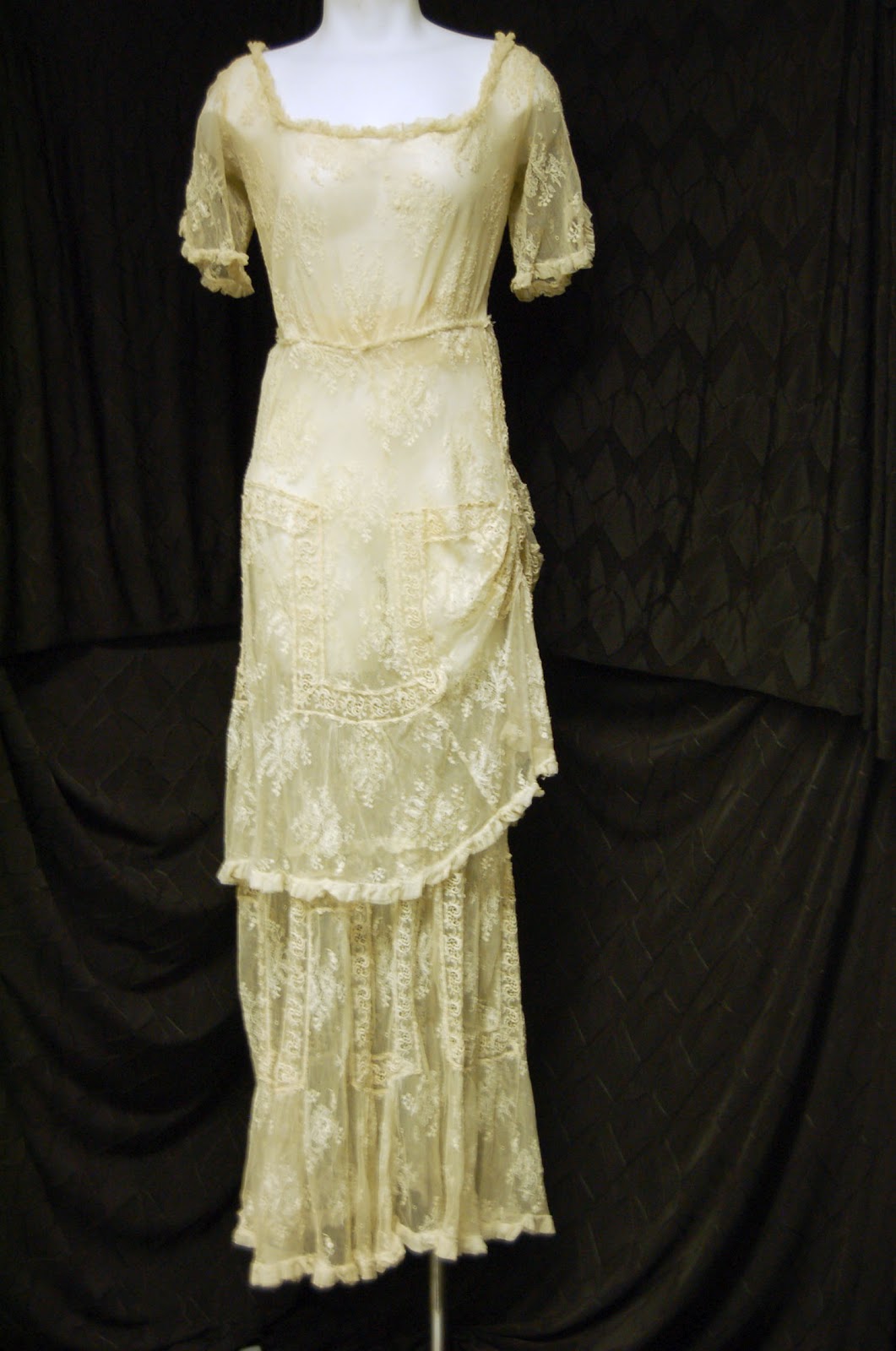
This garment is a cotton and lace day dress, probably from about 1912 or 1913, certainly pre-WWI. It sports the characteristic narrow skirt of the period, with a knee-length wider skirt over top. The light color also dates it to earlier in the period, but the fitted sleeves and shorter sleeves date it a little closer to the start of the war. 
The waistline is high, only a couple of inches below the bust, another common occurrence in early 1910 fashions. The stiff waistband looks like it might have been altered at some point in the 
dress's history, most likely recently, because of some residual hot pink thread. The square neckline of this garment is another good indicator that this garment dates to around 1910. 

       It intrigued me to see that this entire garment is made out of a machine-made net/mesh, overlaid with a Carrickmacross cutwork lace and embroidery, including the small ruffles at the neck, sleeves, and hems of both skirts. Its very very see-through. Fastening wise, the dress fastens closes with a series of hooks and eyes up the back, on both layers of the skirt and on the bodice. 
Over all the garment is in pretty good shape, with only a few small tears and stains.


Some Measurements:

Bust: 36.5"

Waist: 27"

Hip: 30.5"

Neck to Waist Front/back: 9.5/8.5"

Armscye to Armscye front/Back: 19.5/15.5"
                                                                                     
Skirt Length Under/Outer: 40/23"  

Blog Post By Kelsey Oliver :)
                                                                                    

Tuesday, December 6, 2011

Late Edwardian Silk Faille Dress


This dress exemplifies the look from the late Edwardian era. At this time, the skirts became less full and the silhouette became more tubular. The sleeves still were a point of interest, but gone are the gathered leg of mutton and later bishop sleeves of the turn of the century. 


This dress is made of blue-green silk faille with an intricate cut-work lace collar and cuffs. The pleated silk inset echos the sleeves. As you can see from the pictures, the delicate china silk has suffered dry rot.